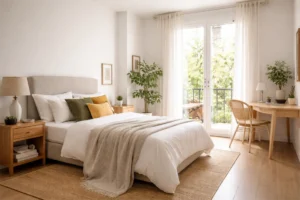
Since its entry into force, Catalonia’s Law 11/2025 on rent control for rooms and seasonal rentals has opened a complex and uncertain terrain. Until now, housing regulations in Catalonia focused on entire dwellings, leaving rooms as a more technical than legal concept, regulated by Habitability Decree 141/2012. However, the legislator has now decided to intervene in the rental market, generating tensions between the technical, administrative, and civil definitions of room rentals.
What is a room under Catalan regulations?
Catalonia’s habitability regulations define rooms as principal spaces within a dwelling, intended for the tenant’s private use. Other areas, such as bathrooms, walk-in closets, or wardrobes, are considered service or auxiliary spaces and do not change the nature of the room.
In other words: even if a room has a private bathroom or a walk-in closet, it remains a part of the dwelling, not an independent housing unit.
It should be emphasized that this is from the perspective of the technical regulation contained in Decree 141/2012 of October 30.
Practical cases and criteria for application
The tension arises when applying this technical definition to the interpretation of “room” under Law 11/2025. Some common situations are:
1. Suites (room with private bathroom)
Although the bathroom increases functional autonomy, it does not convert the room into an independent dwelling: there is no kitchen or separate occupancy certificate. Therefore, the rent limit applies, in line with the social purpose of the law.
2. Attics used as rooms
If they are part of the dwelling and do not have their own occupancy certificate, they are also considered rooms. Even if used exclusively, they remain part of the dwelling and are therefore subject to the rent limit.
3. Duplexes with two independent entrances and shared spaces distributed between floors
Here interpretation becomes more complex and depends on the specific reality of the case. The key factor remains the existence of a single formal housing unit:
- If it lacks a kitchen and a separate occupancy certificate, the rent limit applies.
- If it resembles a fully autonomous unit, it could be defensible not to apply the rent limit.
4. Rooms with walk-in closets
These auxiliary spaces do not change the nature of the room, so the rent limitation remains applicable.
General criteria for resolving conflicts
- Prioritize the technical definition: if there is no independent dwelling according to habitability standards, it is a room.
- Analyse real autonomy: presence of a kitchen, independent access, and separate occupancy certificate may modify the interpretation.
- Avoid interpretations that circumvent the law, maintaining protection for vulnerable tenants.
Final Considerations
In practice, the general rule is clear: all rooms within a dwelling, even if they have a private bathroom or walk-in closet, should be considered under the rent limit. Only fully autonomous housing units, such as studio apartments, could fall outside this limit.